
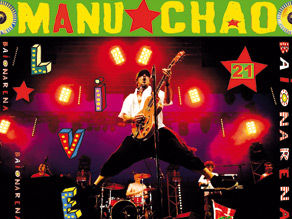
Chao won over many new fans when he road-tested his new material in America this summer.

Chao later worked with former Clash singer Joe Strummer, with whom he formed a strong bond. "He's the only hero I ever met who wasn't a disappointment," Chao says. "He was a great teacher for me - like an uncle."
Manu Chao sings in many languages - French, Spanish, Portuguese, English and Arabic, often mixing several languages in the same song. His music has as many influences as he does languages - blending punk, rock, latin, ska, salsa - giving his songs the taste of the truly global.
Many of Chao's lyrics talk about immigration, love, living in ghettos and drugs - and often carry a left-wing message.
One of his latest projects has been to perform and record in a mental health hospital in Buenos Aires, Argentina. The resulting album, "Colifita" - slang for "lunatic" - is a collaboration with psychiatric patients who run an Argentinian radio station called Radio Loony. Featuring 20 songs about life, love, loneliness, death, sunshine, mothers and the end of the world, it mixes some old Chao tunes with mostly new material from the singer and patients, including poetry and improvizations. The idea, according to the publicity blurb, is to "laugh, cry and meditate about life."


No comments:
Post a Comment